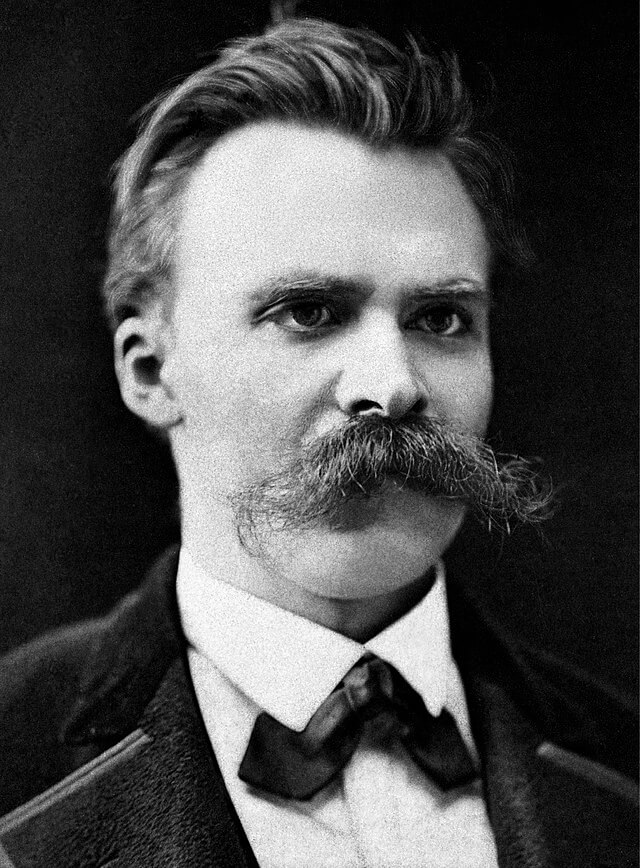
Friedrich Wilhelm Nietzsche (Röcken, Kingdom of Prussia, October 15, 1844 – Weimar, German Empire, August 25, 1900) was a German philosopher, philologist, poet, and cultural critic, regarded as one of the most influential figures of modern Western thought. His work covered topics such as morality, religion, art, truth, history, and nihilism. His aphoristic and provocative style, together with his criticisms of Western culture, have made Nietzsche a key author in contemporary philosophy, although also controversial and often misunderstood.
Early Life and Family Background
Nietzsche was born into a deeply religious family. His father, Carl Ludwig Nietzsche, was a Lutheran pastor, and his mother, Franziska Oehler, came from an equally devout background. His childhood was marked by the premature death of his father when he was five years old and that of his younger brother shortly thereafter. As a result of these losses, he grew up surrounded by female figures: his mother, his sister Elisabeth, and two maternal aunts.
Education and Intellectual Formation
At the age of 14, he entered the state school of Pforta, a prestigious institute focused on humanistic training. There, he became familiar with the Greek and Latin classics, which would later define his philological and philosophical approach. He later studied theology and philology at the University of Bonn, although he quickly abandoned theology. He continued his studies at the University of Leipzig, where he was deeply affected by the work of Arthur Schopenhauer.
Academic Career and Nietzsche’s Relationship with Richard Wagner
In 1869, at the age of just 24, he was appointed Professor of Classical Philology at the University of Basel in Switzerland. This exceptional appointment occurred even before he had completed his doctorate. During his time in Basel, he befriended the composer Richard Wagner, whose work he initially admired, and with whom he shared a common interest in Greek culture.
However, philosophical and ideological differences between the two ultimately led to a definitive rupture. While Wagner leaned towards nationalism and Christianity, Nietzsche progressively moved away from both, questioning traditional values and promoting a new way of thinking.
Health Decline and Departure from Academic Life
Due to chronic health problems—migraines, gastrointestinal disorders, and loss of vision—Nietzsche was forced to resign his professorship in 1879. From then on, he lived on a modest pension. He devoted himself exclusively to writing and reflection, residing in various European cities, especially in Switzerland, Italy, and the south of France.
Nietzsche’s Major Works and Key Philosophical Concepts
Most Influential Works by Nietzsche
Nietzsche’s work is vast, complex, and fragmentary in many respects. His major writings include:
- The Birth of Tragedy (1872)
- Human, All Too Human (1878)
- Thus Spoke Zarathustra (1883–1885)
- Beyond Good and Evil (1886)
- The Genealogy of Morals (1887)
- Twilight of the Idols (1888)
- Ecce Homo (written in 1888, published posthumously)
The Death of God and the Rise of Nihilism
Among his best-known concepts is that of “the death of God,” formulated as a critique of the decline of religious values in modernity. Nietzsche did not propose the death of God as a literal atheistic affirmation, but as a verification of the spiritual void left by the progressive abandonment of traditional faith in Western society.
Another fundamental concept is that of nihilism, understood as the crisis of meaning derived from the loss of absolute values. Nietzsche considered nihilism to be both a threat and an opportunity: a threat because it could lead to existential emptiness, and an opportunity because it opened up the possibility of creating new values.
The Übermensch and the Will to Power
In the face of nihilism, he proposed the figure of the Übermensch (superman), an ideal human being capable of affirming life, creating his own values, and living beyond traditional moral impositions. This idea was misinterpreted in various ideological contexts, particularly during the 20th century.
He also developed the concept of the will to power, a fundamental force that drives life beyond the simple instinct of survival.
The Eternal Return and Affirmation of Life
Also relevant is his conception of the eternal return, which raises the possibility that all events repeat themselves infinitely, as an exercise of radical affirmation of existence.
Personal Life, Relationships, and Final Years
Nietzsche maintained a conflictive relationship with his family environment, especially with his sister Elisabeth. In 1882, he met the Russian writer Lou Andreas-Salomé, with whom he wished to establish an intellectual and affective relationship. However, he was rejected, and the relationship ended tensely. This episode, like others in his personal life, reflected his difficulty in establishing lasting bonds.
Mental Collapse, Hospitalization, and Death
In January 1889, while residing in Turin, he suffered a mental breakdown after witnessing the mistreatment of a horse. From that moment on, his cognitive state deteriorated rapidly. He was hospitalized and spent the last 11 years of his life under the care of his mother and later his sister, without regaining lucidity. The cause of his collapse is still debated, although some theories point to tertiary syphilis, brain tumors, or neurological disorders.
Nietzsche died on August 25, 1900, at the age of 55.
Reception, Misinterpretation, and Philosophical Legacy
Posthumous Reception and Ideological Misuse
During his lifetime, Nietzsche was a marginal author without institutional recognition. His work began to be more widely disseminated after his death, especially through editions published and manipulated by his sister Elisabeth, who had nationalist and anti-Semitic sympathies. These manipulations contributed to the misappropriation of his thought by the Nazi regime, although later studies have shown that Nietzsche was a severe critic of nationalism, anti-Semitism, and authoritarianism.
Nietzsche’s Lasting Influence on Philosophy, Art, and Culture
Nietzsche’s thought has profoundly influenced 20th-century philosophy, in currents such as existentialism, post-structuralism, and depth psychology. His impact also extends to art, literature, cinema, and critical theory.
Far from proposing dogmas, Nietzsche promoted radical criticism of all certainties, inviting a more conscious, autonomous, and affirmative life. His legacy lives on as one of the most provocative and challenging voices of modern thought.
Curious Facts About Friedrich Nietzsche
To close this biography, here are some fascinating and lesser-known facts about Nietzsche that reveal the eccentricities, contradictions, and brilliance of this influential thinker. These curiosities not only add depth to his persona but also help us better understand the unique life behind the philosophy.
1. He Never Held a PhD
Although Nietzsche became a professor at the University of Basel at the age of just 24, he never completed a doctoral thesis. His appointment was so exceptional that it bypassed traditional academic requirements—a rare event in university history.
2. Nietzsche Was Also a Composer
Before turning fully to philosophy, Nietzsche composed several pieces of classical music for piano. His emotional connection to music deeply influenced his writing style and worldview, especially in works like The Birth of Tragedy.
3. His Mustache Became a Pop Icon
Nietzsche’s enormous, bushy mustache was more than just facial hair—it became a recognizable trademark. Over time, it has appeared in modern caricatures, parodies, posters, and even internet culture.
4. He Walked for Hours to Think
Nietzsche often walked up to eight hours a day, claiming that walking was essential to his thinking process. Many of his philosophical insights were born during solitary hikes through the Alps or along Mediterranean paths.
5. He Preferred Aphorisms Over Systems
Rejecting rigid academic structures, Nietzsche favored short, sharp aphorisms—concise philosophical insights that often read like poetry. This made his work both memorable and radically different from his contemporaries.
6. He Predicted His Own Misunderstanding
In a striking moment of self-awareness, Nietzsche wrote: “Some are born posthumously.” He foresaw that his work would only be understood and appreciated long after his death—a prophecy that history fulfilled.
7. Nietzsche Opposed Nationalism
Although often misused by totalitarian ideologies, Nietzsche firmly rejected German nationalism, antisemitism, and militarism. His writings often criticize herd mentality and blind patriotic fervor, advocating instead for individual freedom and intellectual integrity.