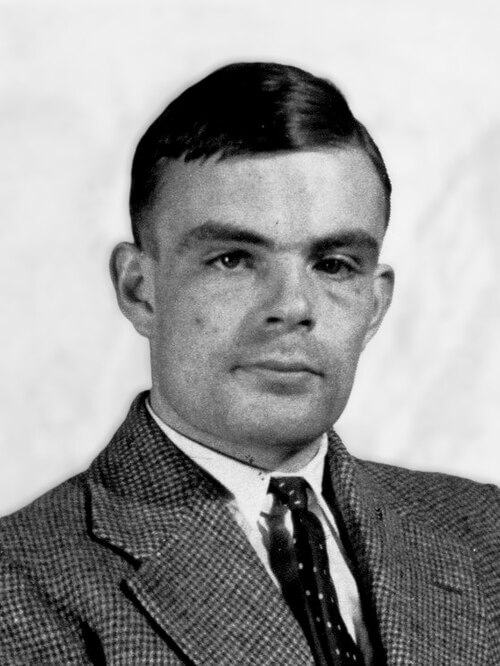
Alan Turing
Alan Mathison Turing (London, June 23, 1912 – Wilmslow, Cheshire, June 7, 1954) was a British mathematician, logician, cryptanalyst, and pioneer in theoretical computer science, artificial intelligence, and cryptography. He is widely regarded as a foundational figure in the development of modern computing. Turing’s contributions during World War II, particularly in breaking the Enigma cipher used by Nazi Germany, played a crucial role in the Allied victory.
Early Life and Education
Turing was born in Maida Vale, London, into an upper-middle-class family. He exhibited exceptional aptitude in mathematics and science from an early age. He attended Sherborne School in Dorset before enrolling at King’s College, University of Cambridge, in 1931, where he earned a degree in mathematics and was elected a Fellow in 1935.
In 1936, he published the seminal paper «On Computable Numbers, with an Application to the Entscheidungsproblem», which introduced the concept of the Turing machine—a theoretical model of computation that laid the foundation for the modern computer science discipline.
He pursued graduate studies at Princeton University, completing a Ph.D. in 1938 under Alonzo Church, focusing on mathematical logic and cryptography.
World War II and Cryptanalysis
At the onset of World War II, Turing joined the Government Code and Cypher School (GC&CS) at Bletchley Park, the United Kingdom’s principal decryption facility. His primary mission was to break the German Enigma cipher, used for secure military communications.
Turing developed an electromechanical device known as the Bombe, which automated the decryption process and significantly accelerated codebreaking efforts. His work, alongside that of Gordon Welchman and others, enabled near real-time interception and decoding of German communications. Historians estimate that these efforts shortened the war by at least two years and saved millions of lives.
He also contributed to the decryption of the Kriegsmarine’s (German Navy’s) Enigma settings, which proved essential to securing Allied shipping routes in the Atlantic.
Contributions to Computing and Artificial Intelligence
After the war, Turing worked at the National Physical Laboratory (NPL), where he proposed the Automatic Computing Engine (ACE), one of the earliest designs for a stored-program digital computer. Although a full-scale ACE was not built during his tenure, his work heavily influenced future computer architectures.
In 1948, Turing joined the University of Manchester, contributing to the development of the Manchester Mark I, one of the first operational stored-program computers.
That same year, he began exploring concepts in artificial intelligence and machine cognition. In 1950, he published the influential paper “Computing Machinery and Intelligence”, introducing the Turing Test—a method for evaluating whether a machine can exhibit human-like intelligent behavior.
Prosecution and Legal Consequences
Turing was openly homosexual, a sexual orientation that was criminalized in the United Kingdom at the time. In 1952, he was charged with “gross indecency” after admitting to a consensual relationship with another man. Convicted, he was given the choice between imprisonment and chemical castration via estrogen therapy; he chose the latter.
The conviction led to the revocation of his security clearance, barring him from continuing sensitive research for the government and significantly affecting his personal and professional life.
Death
On June 7, 1954, Turing was found dead in his home in Wilmslow, Cheshire, from cyanide poisoning. A half-eaten apple was found next to his body, though it was never tested. The official cause of death was ruled a suicide, although accidental poisoning has also been suggested by some researchers.
Posthumous Recognition
Much of Turing’s wartime work remained classified for decades, delaying full public recognition. In 2009, British Prime Minister Gordon Brown issued a formal apology for the government’s treatment of Turing. In 2013, Queen Elizabeth II granted him a posthumous royal pardon.
In 2021, Turing’s portrait was featured on the Bank of England’s £50 note, commemorating his impact on science and society.
Numerous institutions, awards, and research centers now bear his name. The Turing Award, considered the highest honor in computer science, is named in his legacy. Turing is also recognized globally as a symbol of the struggle for LGBTQ+ rights and scientific integrity.
Notable Facts About Alan Turing
Alan Turing’s impact goes well beyond his foundational work in mathematics and computing. The following list highlights unique and often overlooked facts that demonstrate the depth of his legacy and cultural significance.
1. Inventor of the Turing Machine
In 1936, Turing introduced the concept of a theoretical machine capable of simulating any algorithm. This idea became the cornerstone of modern computer science.
2. Helped Shorten World War II
Turing’s creation of the Bombe machine dramatically accelerated the decoding of encrypted Nazi communications, helping to end the war at least two years earlier and saving millions of lives.
3. Received a Royal Pardon
In 2013, Queen Elizabeth II granted a posthumous pardon for his 1952 conviction, recognizing the injustice he suffered due to laws against homosexuality.
4. Namesake of the Turing Award
The Turing Award, established in 1966 by the Association for Computing Machinery (ACM), is considered the highest honor in computer science.
5. Featured on the £50 Banknote
In 2021, the Bank of England issued a £50 note featuring Turing’s image, celebrating his contributions to science, technology, and society.
6. Made Contributions to Mathematical Biology
Turing’s 1952 paper on morphogenesis provided a mathematical explanation for natural patterns such as stripes on animals, influencing biology and systems theory.
7. Work Remained Classified for Decades
Much of Turing’s wartime codebreaking work remained a state secret until the 1970s, delaying public recognition of his achievements.
8. Honored with a Statue in Manchester
A public statue of Alan Turing stands in Sackville Gardens, Manchester, symbolizing both his scientific genius and the injustice he endured.