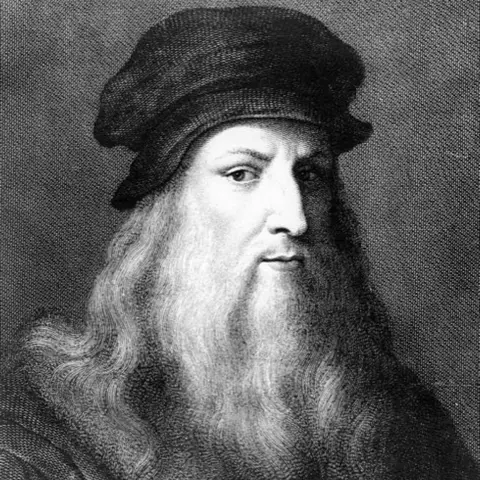
Leonardo da Vinci (April 15, 1452 – May 2, 1519) was an Italian polymath of the Renaissance era, renowned for his groundbreaking contributions to art, science, engineering, anatomy, and architecture. His unique integration of art and science made him one of the most influential figures in history. Leonardo’s ability to seamlessly combine creativity and empirical investigation allowed him to produce works and ideas centuries ahead of his time, securing his legacy as a symbol of the Renaissance humanist ideal.
Early Life and Education
Leonardo was born on April 15, 1452, in the small town of Vinci, located in the Tuscany region of Italy. He was the illegitimate son of Ser Piero da Vinci, a respected Florentine notary, and Caterina, a peasant woman from the region. Despite his illegitimate status, Leonardo was raised in his father’s household and received an informal education. The social ambiguity of his birth may have given him the freedom to explore diverse interests without the typical expectations of nobility or inheritance.
From an early age, Leonardo exhibited an insatiable curiosity and keen observational skills. His natural talent was evident in both artistic and scientific pursuits, and he was encouraged to learn through direct experience rather than traditional scholastic methods. At the age of 14, Leonardo began a formal apprenticeship with Andrea del Verrocchio, one of Florence’s most prominent artists and craftsmen. Under Verrocchio’s tutelage, Leonardo mastered a variety of disciplines, including painting, sculpture, metallurgy, mechanical engineering, and drafting.
This apprenticeship was critical in shaping Leonardo’s interdisciplinary approach. Unlike many contemporaries who specialized in a single craft, Leonardo’s exposure to multiple fields fostered his ability to see connections between seemingly unrelated areas. His education was heavily influenced by Renaissance humanism, which emphasized the study of classical texts, anatomy, and nature. This intellectual environment encouraged him to challenge traditional knowledge and pursue innovation.
Leonardo’s notebooks reveal his early fascination with anatomy, geometry, and mechanical devices. He made detailed sketches of natural phenomena, animals, and human anatomy, blending art with scientific inquiry. This period laid the foundation for his later masterpieces and inventions. His early education also included the study of Latin and mathematics, vital for understanding classical texts and engineering principles.
Artistic Career
Leonardo da Vinci’s artistic career is marked by a pioneering spirit and technical mastery that transformed Renaissance art. He is credited with developing the technique of sfumato, a method that uses delicate gradations of tone and color to create a smoky, blurred effect, allowing soft transitions between light and shadow. This technique enabled him to achieve a lifelike realism and emotional depth previously unseen in Western painting.
Among his many artworks, the Mona Lisa stands out as the most famous portrait in art history. Painted between 1503 and 1506, the Mona Lisa is renowned for its enigmatic smile and masterful use of light and shadow, which imbues the painting with a sense of mystery and psychological complexity. The portrait’s composition and the sitter’s subtle expression have fascinated viewers and scholars alike for centuries. Leonardo’s attention to detail, from the texture of the skin to the atmospheric background, exemplifies his scientific approach to observation.
Another monumental work is The Last Supper, created between 1495 and 1498 during Leonardo’s tenure at the court of Ludovico Sforza in Milan. This large mural depicts the moment Jesus announces one of his disciples will betray him, capturing a wide range of human emotions and reactions. The composition is celebrated for its dramatic narrative and use of perspective, which guides the viewer’s eye toward Christ at the center. Leonardo’s experimental fresco technique unfortunately caused deterioration, but the work’s influence on religious art remains profound.
Throughout his career, Leonardo’s artistic style evolved, blending precise anatomical studies with poetic expression. His drawings, such as the Vitruvian Man, demonstrate his quest to harmonize human proportions with geometric principles, linking art, science, and philosophy. Leonardo’s art was not merely decorative but served as a vehicle for exploring the nature of reality and human experience.
He was also known for his innovative use of chiaroscuro (the contrast of light and dark) and his ability to depict textures realistically, from skin to fabric to natural landscapes. Although relatively few paintings are definitively attributed to him, each work profoundly impacted the development of Western art, inspiring generations of artists.
Scientific and Technical Work
Leonardo da Vinci’s scientific and technical endeavors reveal the breadth of his intellect and his pioneering contributions to multiple disciplines. His scientific investigations were deeply rooted in empirical observation and experimentation, a method that prefigured modern scientific inquiry.
One of his most significant contributions was in the field of human anatomy. Leonardo conducted numerous dissections of human corpses, meticulously studying the structure and function of muscles, bones, organs, and the vascular system. His anatomical drawings are remarkably accurate and detailed, often accompanied by explanatory notes written in his characteristic mirror script. These studies not only enhanced his artistic ability to depict the human form realistically but also advanced medical knowledge, influencing future anatomists.
Leonardo’s curiosity extended to mechanics and engineering. He conceptualized and sketched designs for a variety of machines, many centuries ahead of practical realization. Among his inventions were early prototypes for flying machines inspired by the flight of birds, including ornithopters and aerial screws that resemble helicopters. He also designed armored vehicles, bridges, cranes, and water pumps, applying principles of leverage, hydraulics, and mechanics.
In the realm of optics, Leonardo explored the behavior of light and vision, including the camera obscura principle, which informed his techniques for perspective and shading in art. His studies on hydraulics led him to design canals and irrigation systems, reflecting his interest in environmental engineering.
Leonardo’s notebooks are a testament to his polymathic approach, covering topics from geology and botany to astronomy and acoustics. His scientific work remained largely unpublished during his lifetime, but the rediscovery of his manuscripts centuries later revealed a visionary mind bridging the gap between art and science.
Milan Period
From 1482 to 1499, Leonardo worked at the court of Ludovico Sforza, Duke of Milan, a period marked by prolific artistic and engineering output. Leonardo presented himself not only as an artist but also as a military engineer and inventor, as emphasized in his famous letter to Ludovico. In this letter, Leonardo listed his capabilities, including designing bridges, fortifications, weapons, and machinery, highlighting his multidisciplinary expertise.
During this period, Leonardo completed The Last Supper, which remains one of the most studied and revered artworks in history. Beyond painting, he was engaged in architectural projects, urban planning, and the development of complex machines. His work extended to stage design, creating elaborate theatrical spectacles that combined art and engineering.
Leonardo also contributed to engineering projects, such as canal construction and improvements to the city’s defenses. He designed innovative machinery intended for both civilian and military use, showcasing his inventive genius.
This period in Milan was also marked by intense collaboration and competition with other artists and engineers, which stimulated Leonardo’s creativity. However, the fall of the Sforza family in 1499 forced Leonardo to leave Milan and move to other Italian cities, including Florence and Rome, continuing his diverse pursuits.
Later Years
After his Milanese period, Leonardo returned to Florence and later worked in Rome, where he faced challenges finding patronage amid political and artistic rivalries. Despite these difficulties, he continued to pursue both artistic commissions and scientific studies.
In 1516, Leonardo accepted an invitation from King Francis I of France and moved to the Château du Clos Lucé near Amboise. Here, he spent his final years under royal patronage, supported to continue his studies and creations. During this time, he advised on architectural projects, hydraulic engineering, and military fortifications.
Though his health declined in his later years, Leonardo remained intellectually active, dictating ideas and designs to his assistants. He continued working on anatomical drawings and mechanical inventions until his death on May 2, 1519.
Legacy
Leonardo da Vinci epitomizes the Renaissance ideal of the “universal man,” whose expertise spanned art, science, and technology. His innovative painting techniques revolutionized the visual arts, influencing countless artists and shaping the course of Western painting. His scientific notebooks reveal a mind dedicated to rigorous observation and experimentation, foreshadowing principles of the modern scientific method.
Leonardo’s influence extends beyond art and science; he symbolizes creativity, curiosity, and the relentless pursuit of knowledge. His multidisciplinary approach continues to inspire scholars, scientists, and artists worldwide. The preservation and study of his notebooks have revealed insights into anatomy, engineering, optics, and more, confirming his status as a visionary thinker.
Notable Works
- Vitruvian Man – A drawing illustrating ideal human proportions, merging art and geometry.
- Mona Lisa – The world’s most famous portrait, noted for its enigmatic expression and technical mastery.
- The Last Supper – A landmark fresco capturing the drama of Christ’s final meal with his disciples.
Interesting Facts About Leonardo da Vinci
- Leonardo da Vinci was ambidextrous but predominantly left-handed, which influenced his unique mirror-writing style.
- He filled over 7,000 pages of notebooks with sketches and ideas, many of which were centuries ahead of their time.
- Despite his fame as an artist, Leonardo considered himself primarily an inventor and scientist.
- He dissected human corpses to gain a deep understanding of anatomy, contributing foundational knowledge to modern medicine.
- Leonardo’s Mona Lisa was never delivered to its patron; he kept it with him until his death.
- His concept designs included early prototypes of the helicopter, parachute, armored tank, and even a robot knight.
- Leonardo had a lifelong fascination with flight and closely studied bird wings to inspire his flying machine designs.
- He was also a skilled musician and played the lyre, often creating his own musical instruments.
- Leonardo rivaled Michelangelo in a famous artistic competition, highlighting contrasting Renaissance styles.
- Many of Leonardo’s inventions were never built in his lifetime, partly because they required materials or technologies unavailable in the 15th century.