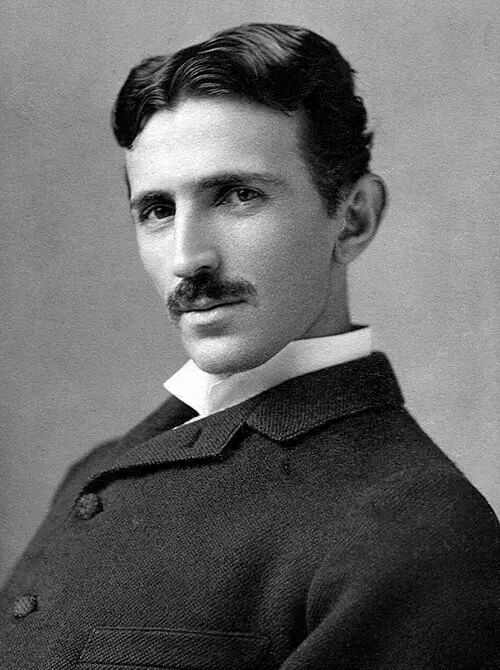
Nikola Tesla
Nikola Tesla (Smiljan, Austrian Empire —modern-day Croatia— July 10, 1856 – New York City, United States, January 7, 1943) was a Serbian-American inventor, electrical engineer, mechanical engineer, and futurist. He is best known for his pioneering work in the development of alternating current (AC) electricity systems, which became the global standard for electrical transmission and distribution. Tesla held over 300 patents and contributed significantly to fields including electromagnetism, radio technology, robotics, and wireless energy.
Early Life and Education
Tesla was born to a Serbian Orthodox family. His father, Milutin Tesla, was a priest and writer, while his mother, Đuka Mandić, possessed a strong talent for mechanical invention, despite having no formal education. Tesla later credited her as a major influence on his interest in science and invention.
He began studying engineering at the Austrian Polytechnic in Graz, where he became deeply interested in electricity. He later enrolled at Charles University in Prague, but left without earning a degree. Despite not completing formal education, Tesla developed a strong theoretical foundation in physics, mathematics, and engineering.
Early Career in Europe and Move to the United States
Tesla’s professional career began in the European electrical and telecommunications industries. In 1881, while working at a telephone exchange in Budapest, he conceived the principle of the rotating magnetic field, which would later be central to AC motor design. In Paris, he joined the Continental Edison Company, where he gained practical experience in electrical systems.
In 1884, Tesla immigrated to the United States and arrived in New York City with a letter of recommendation for Thomas Edison. He briefly worked for Edison but left due to technical and ideological differences, particularly over the debate between direct current (DC) and alternating current (AC) systems.
Alternating Current and the War of the Currents
Tesla became a key proponent of alternating current, which he believed was more efficient for long-distance power transmission. His AC motor designs and transformer innovations attracted the attention of George Westinghouse, who purchased Tesla’s patents and supported the commercial rollout of AC power systems.
This partnership led to the War of the Currents, a fierce industrial rivalry between Edison’s DC system and the Tesla-Westinghouse AC system. The conflict culminated in 1893, when Tesla and Westinghouse successfully powered the World’s Columbian Exposition in Chicago using AC. This event played a pivotal role in establishing alternating current as the dominant standard worldwide.
Key Inventions and Contributions
Tesla’s inventions laid the groundwork for numerous modern technologies. Notable innovations include:
- The induction motor for alternating current
- The Tesla coil, used for generating high-voltage, high-frequency currents
- The polyphase AC power distribution system
- Radio-controlled devices, first demonstrated in 1898
- Early theoretical work on radio, preceding Marconi’s practical implementations
In addition, Tesla explored:
- Wireless power transmission
- Radio frequency communication
- Fluorescent lighting
- Preliminary concepts of radar, remote control, and robotics
Laboratories and Experiments
In 1899, Tesla established a laboratory in Colorado Springs, where he conducted experiments on high-voltage electricity and wireless energy transmission. He claimed to have received cosmic signals during this period, which he interpreted as potential evidence of extraterrestrial communication.
In 1901, Tesla began building the Wardenclyffe Tower on Long Island, New York, with funding from J.P. Morgan. The tower was intended to transmit wireless electricity and global communications across the Atlantic. However, the project was eventually abandoned due to financial constraints and a lack of commercial viability.
Later Years and Death
In his later years, Tesla lived modestly in New York City hotels, surviving on limited funding and pensions. He continued to work on speculative projects such as wireless energy transmission, global communications systems, and theoretical weapons like the so-called «death ray».
Tesla died on January 7, 1943, at the age of 86, in the Hotel New Yorker. At the time, his death received limited public attention, but his legacy has since been widely acknowledged and celebrated.
Posthumous Recognition and Legacy
In 1943, the United States Supreme Court acknowledged Tesla’s priority in the invention of radio by invalidating several of Guglielmo Marconi’s patents, crediting Tesla’s earlier work. His contributions have since been honored globally.
Tesla’s enduring legacy includes:
- The «tesla» (T), the SI unit of magnetic flux density, is named in his honor
- Numerous monuments, museums, and institutions are dedicated to his life and work
- Inspiration for popular culture and science fiction
- The naming of the electric vehicle and clean energy company Tesla, Inc.
Interesting Facts about Nikola Tesla
- Tesla had a photographic memory and could visualize complex machinery entirely in his mind before constructing prototypes.
- He reportedly slept only two hours per night and followed a strict work schedule, often working up to 20 hours a day.
- Tesla had a lifelong aversion to pearls and refused to speak to women wearing them, claiming it caused him physical discomfort.
- In 1899, while experimenting in Colorado Springs, he believed he received signals from intelligent extraterrestrial life.
- He never married, stating that scientific work demanded all of his attention and energy.
- Tesla developed a deep affection for pigeons and spent considerable time and money caring for injured birds in New York.
- In 1898, he publicly demonstrated a wireless, remote-controlled boat, a pioneering concept in robotics and radio control.
- He envisioned technologies resembling Wi-Fi, smartphones, and drones decades before they became a reality.
- The SI unit of magnetic flux density, the tesla (T), was named after him in 1960 to honor his contributions to electromagnetism.
- Although nominated, Tesla never won the Nobel Prize and even declined several awards during his lifetime, valuing his scientific ideals above recognition.