Saddam Hussein
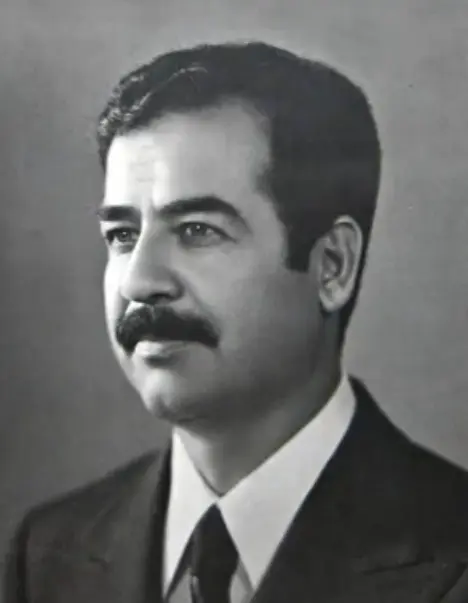
Saddam Hussein Abd al-Majid al-Tikriti (April 28, 1937 – December 30, 2006) was an Iraqi politician and authoritarian ruler who served as the President of Iraq from 1979 until 2003. A leading figure in the Arab Socialist Ba’ath Party, Hussein became synonymous with brutal repression, militarized nationalism, and a personality cultthat dominated Iraq’s political, social, and cultural life for over two decades. His leadership was marked by internal purges, international conflicts, the use of chemical weapons, and severe human rights abuses. He was overthrown during the U.S.-led invasion of Iraq in 2003 and executed in 2006 for crimes against humanity.
Early Life and Education
Saddam Hussein was born in the rural village of Al-Awja, near Tikrit, in northern Iraq. He came from a poor Sunni Arab farming family. His father either died or vanished before his birth, and his older brother passed away in infancy. Raised primarily by his maternal uncle, Khairallah Tulfah, a former army officer and fervent Iraqi nationalist with pro-Nazi sympathies, Hussein’s early life was shaped by economic hardship, domestic instability, and authoritarian influence.
His education was sporadic due to poverty and political turbulence, but he eventually completed secondary schooling and later pursued legal studies in Cairo, Egypt, after fleeing Iraq in the late 1950s due to his involvement in anti-government activities.
Political Beginnings and Rise in the Ba’ath Party
In the mid-1950s, Saddam joined the Arab Socialist Ba’ath Party, which espoused pan-Arabism, secularism, and Arab socialism. In 1959, he participated in an assassination attempt against then–Prime Minister Abd al-Karim Qasim, an operation that failed and forced him into exile in Syria and Egypt.
He returned to Iraq after Qasim was deposed in 1963. Although the Ba’athists briefly held power that year, they were quickly ousted, and Saddam was imprisoned. He escaped in 1967 and focused on rebuilding the party underground, establishing a strong internal network of loyalists that would later become the backbone of his regime.
Consolidation of Power (1968–1979)
In July 1968, the Ba’ath Party orchestrated a coup d’état that returned it to power. Saddam was named Vice Presidentunder General Ahmed Hassan al-Bakr, but he quickly emerged as the regime’s true power center. He took control of key areas such as internal security, intelligence, and party discipline, using surveillance, purges, and fear to eliminate opposition.
By 1979, Saddam compelled al-Bakr to resign and formally assumed the presidency. Shortly thereafter, he staged a televised purge of senior Ba’ath Party members, accusing them of conspiracy and ordering their execution. This event solidified his absolute authority.
Presidency and Authoritarian Rule (1979–2003)
Saddam Hussein’s presidency was defined by centralized power, extensive propaganda, and brutal repression. He cultivated a cult of personality with his image displayed in public spaces, classrooms, media, currency, and even religious sermons. The regime projected him as a national savior, military strategist, and guardian of Arab and Islamic identity.
Economic Growth and Surveillance State
Iraq saw significant economic development in the 1970s and early 1980s due to booming oil revenues. Saddam’s government invested heavily in education, infrastructure, healthcare, and industrialization, while nationalizing oil production and other sectors. However, these gains were accompanied by an increasingly oppressive surveillance state. Citizens were monitored by secret police, dissent was criminalized, and political indoctrination permeated education and media.
Military Conflicts and Regional Ambitions
Iran–Iraq War (1980–1988)
In September 1980, Saddam launched a military invasion of Iran, capitalizing on post-revolutionary chaos. The Iran–Iraq War lasted eight years, resulting in more than one million deaths and widespread destruction. Iraq used chemical weapons against both Iranian forces and Kurdish civilians, most notably in the Halabja chemical attack in 1988, where over 5,000 people were killed.
Though the war ended in a stalemate, Iraq emerged economically drained and deeply in debt, especially to neighboring Gulf states.
Invasion of Kuwait and Gulf War (1990–1991)
In August 1990, Saddam invaded Kuwait, citing economic disputes and territorial claims. This act prompted a U.S.-led international coalition to launch Operation Desert Storm in January 1991. The Iraqi military was swiftly defeated, and Kuwait was liberated.
In the war’s aftermath, UN sanctions were imposed on Iraq, causing a severe humanitarian crisis, including food and medicine shortages. Despite these hardships, Saddam remained in power, crushing Shiite and Kurdish uprisings in 1991 with massive force, including the use of artillery and helicopters against civilians.
Decline and Fall (1991–2003)
Throughout the 1990s, Saddam’s regime faced growing isolation, economic hardship, and domestic unrest. The UN sanctions regime persisted, and international scrutiny over Iraq’s weapons programs increased. Saddam used state-controlled media to deflect blame, portraying himself as a victim of Western aggression.
Following the 9/11 terrorist attacks, the U.S. government under President George W. Bush labeled Iraq part of the “Axis of Evil,” although no direct links between Saddam and Al-Qaeda were ever established. In March 2003, the U.S. and the United Kingdom, citing Iraq’s alleged weapons of mass destruction (WMDs), launched a military invasionof Iraq without explicit UN authorization.
By April 2003, Baghdad had fallen. Saddam’s government collapsed, and he went into hiding.
Capture, Trial, and Execution
Saddam Hussein was captured on December 13, 2003, by U.S. forces near Tikrit, hiding in an underground bunker. He was handed over to the Iraqi interim government and stood trial for crimes against humanity, most notably the 1982 Dujail massacre, where 148 Shiite villagers were executed following an assassination attempt.
His highly publicized trial began in 2005 and ended with a guilty verdict. Saddam was sentenced to death and executed by hanging on December 30, 2006.
Legacy and Impact
Saddam Hussein remains one of the most polarizing figures in modern Middle Eastern history. His dictatorship was characterized by torture, genocide, state terror, and militarized nationalism. The internal purges, foreign wars, and brutal suppression of ethnic and political minorities under his rule led to millions of deaths and displacements.
Although some view him as a symbol of Arab resistance to Western intervention, the global consensus largely regards Saddam Hussein as a repressive tyrant whose actions destabilized Iraq and contributed to the rise of extremist groups like Al-Qaeda in Iraq and later the Islamic State (ISIS). The power vacuum created after his fall plunged Iraq into years of sectarian violence, political fragmentation, and humanitarian crises.
Interesting Facts About Saddam Hussein
- The name «Saddam» means «one who confronts» in Arabic, aligning with his aggressive political persona.
- He authored several romance novels and poetry books, which were published under his name and distributed nationwide by state-run media.
- Saddam Hussein’s image appeared on Iraqi dinar notes, coins, and stamps, reinforcing a pervasive cult of personality.
- He ordered the construction of more than 1,000 statues of himself, symbolizing power and omnipresence across Iraq.
- In 1979, he orchestrated a televised purge of senior Ba’ath officials, accusing them of treason and executing them publicly to consolidate control.
- Despite leading a secular regime, Saddam adopted religious titles, such as «Defender of the Faith» to gain legitimacy among conservative Muslims.
- He reportedly survived over 20 assassination attempts, many involving foreign intelligence agencies and internal rivals.
- During the Iran–Iraq War, he received tactical support from both the West and the Soviet bloc, reflecting Iraq’s geopolitical importance.
- He had over 70 presidential palaces, some lavishly built during the UN sanctions era, contrasting with widespread poverty in Iraq.
- Saddam Hussein was known for his fear of flying, often preferring long car journeys to reduce security risks.