Pablo Escobar
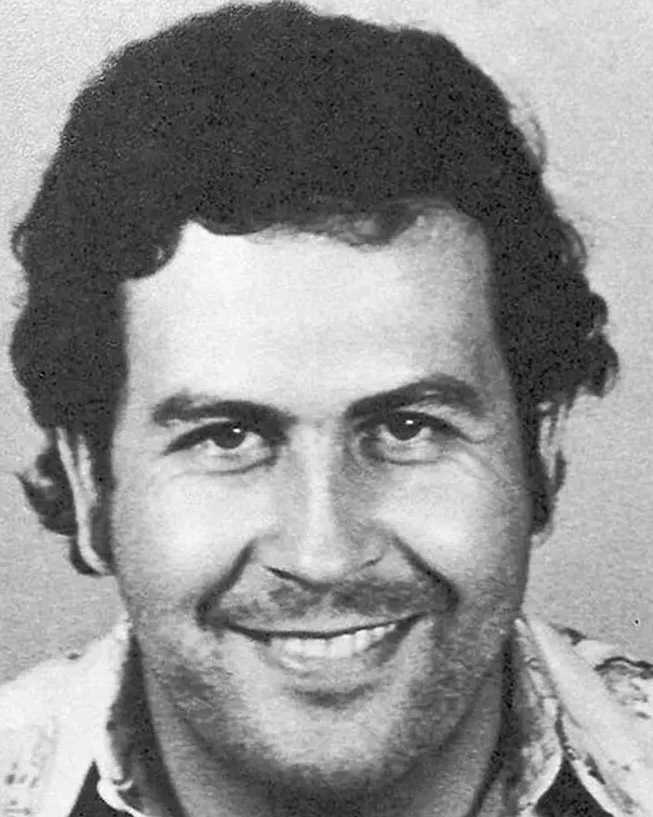
Pablo Emilio Escobar Gaviria (Rionegro, Antioquia; December 1, 1949 – Medellín; December 2, 1993) was a Colombian drug trafficker, politician, and organized crime leader, best known as the founder and head of the Medellín Cartel. He is widely regarded as one of the most powerful, violent, and influential drug lords in modern history. During the 1980s and early 1990s, his cartel controlled a major share of the global cocaine trade.
At the height of his power, Escobar’s personal fortune exceeded $8 billion, according to Forbes. His dominance over drug trafficking networks and his interference in Colombian politics, law enforcement, and society contributed to a dramatic rise in violence, including targeted assassinations, terrorist attacks, and systematic bribery.
Early Life and Background
Pablo Escobar was born in Rionegro, Antioquia, Colombia, and raised in nearby Envigado. He was the third of seven children born to Abel de Jesús Escobar Echeverri, a farmer, and Hermilda Gaviria, a schoolteacher.
He briefly studied law and political science at the Universidad Autónoma Latinoamericana but left without obtaining a degree. Escobar became involved in petty crime during his youth, engaging in activities such as cigarette smuggling, selling fake lottery tickets, and stealing tombstones to resell them.
These early criminal enterprises laid the foundation for his entry into the drug trafficking world.
Entry into Cocaine Trafficking
In the 1970s, Escobar, along with his cousin Gustavo Gaviria, became involved in the growing cocaine market. They created a distribution network sourcing coca paste from Peru and Bolivia, processing it in Colombia, and smuggling it primarily to the United States, where demand was increasing sharply.
Escobar consolidated power by eliminating rivals, including Fabio Restrepo, and emerged as the leader of the Medellín Cartel. By the mid-1980s, the cartel controlled an estimated 80% of the world’s cocaine supply.
Medellín Cartel Operations
The Medellín Cartel operated with a paramilitary structure and was known for its brutal enforcement tactics. Key members included:
- Carlos Lehder
- Gonzalo Rodríguez Gacha
- The Ochoa brothers
At its peak, the cartel generated approximately $70 million per day and smuggled over 15 tons of cocaine daily into the U.S. Escobar used this immense wealth to bribe officials, secure political leverage, and influence military and judicial institutions.
Political Career
In 1982, Escobar was elected as an alternate member of the Colombian Chamber of Representatives through the Liberal Alternative party. He used this position to gain legal protection and social credibility. During this time, he financed housing projects and public works in poor neighborhoods, cultivating a Robin Hood-like image among segments of the population.
His political ambitions ended when Minister of Justice Rodrigo Lara Bonilla publicly denounced his drug ties. Lara was later assassinated in 1984, a turning point that escalated the conflict between the Colombian government and Escobar’s cartel.
Anti-Extradition Campaign and Terrorism
Escobar vehemently opposed extradition to the United States and launched a violent campaign to halt it. This included:
- Assassination of Luis Carlos Galán (1989), a leading presidential candidate
- Avianca Flight 203 bombing (1989), killing 110 people
- Car bombing of DAS intelligence headquarters (1989), over 60 fatalities
- Systematic killings of judges, journalists, and political officials
These acts classified the Medellín Cartel as a narco-terrorist organization, intensifying efforts by Colombian and U.S. authorities to dismantle it.
Surrender and La Catedral Prison
In 1991, Escobar negotiated his surrender to President César Gaviria’s government. In return, he secured amnesty from extradition and was allowed to build his own luxury prison, known as La Catedral, near Envigado.
The facility included:
- A nightclub
- Private soccer field
- Jacuzzi and gourmet kitchen
- Satellite communications
Despite being officially imprisoned, Escobar continued to run cartel operations from La Catedral. In 1992, when authorities attempted to transfer him to a conventional prison, Escobar escaped.
Death and Aftermath
After his escape, the Search Bloc (a special Colombian police task force), supported by the DEA, CIA, and paramilitary group Los Pepes (People Persecuted by Pablo Escobar), launched an extensive manhunt.
On December 2, 1993, one day after his 44th birthday, Escobar was located in Medellín after a phone call was traced. During an attempted rooftop escape, he was shot and killed. It remains unclear whether Escobar died from police gunfire or committed suicide.
Legacy and Cultural Impact
Escobar’s legacy remains controversial. He is widely viewed as a ruthless criminal responsible for thousands of deaths, yet some remember him for his philanthropy in Medellín’s poorest neighborhoods.
Key elements of his legacy include:
- «Narco-culture»: His life has inspired numerous TV series (e.g., Narcos), movies, books, and documentaries.
- Hacienda Nápoles: Former private estate turned theme park.
- Escobar Neighborhood: A Medellín district he helped develop still bears his name.
Following his death, Escobar’s family fled to Argentina. His son, Juan Pablo Escobar (now Sebastián Marroquín), has become a public figure advocating for peace and reconciliation, authoring several books and documentaries.
Interesting Facts about Pablo Escobar
- He offered to pay off Colombia’s national debt.
At the peak of his fortune, Escobar reportedly offered the Colombian government to pay off its $10 billion foreign debt in exchange for amnesty. - His cartel spent $2,500 per month on rubber bands.
The Medellín Cartel had to bundle so much cash that it reportedly spent thousands of dollars monthly just on rubber bands. - He lost millions to rats and moisture.
Escobar allegedly lost over $1 billion annually due to cash being eaten by rats or damaged by water in hidden stash houses. - He was once the seventh-richest man in the world.
In 1989, Forbes ranked him as the world’s 7th richest person with an estimated net worth of $9 billion. - He built his own prison.
“La Catedral” included a bar, soccer field, Jacuzzi, and waterfall. It also had no real guards — just cartel loyalists. - He imported exotic animals illegally.
His private zoo at Hacienda Nápoles included elephants, giraffes, zebras, and hippos — some of which now roam wild in Colombia. - He burned $2 million in cash to keep his daughter warm.
While in hiding, Escobar reportedly burned stacks of cash to prevent his daughter from freezing during the night. - He financed housing for Medellín’s poor.
He built hundreds of homes in the Barrio Pablo Escobar, which still exists today and bears his name. - His phone calls led to his capture.
Despite intense security measures, authorities located Escobar by triangulating signals from a phone call to his son. - There is an active debate over his death.
Some claim he was shot by police; others, including his family, believe Escobar took his own life to avoid capture.