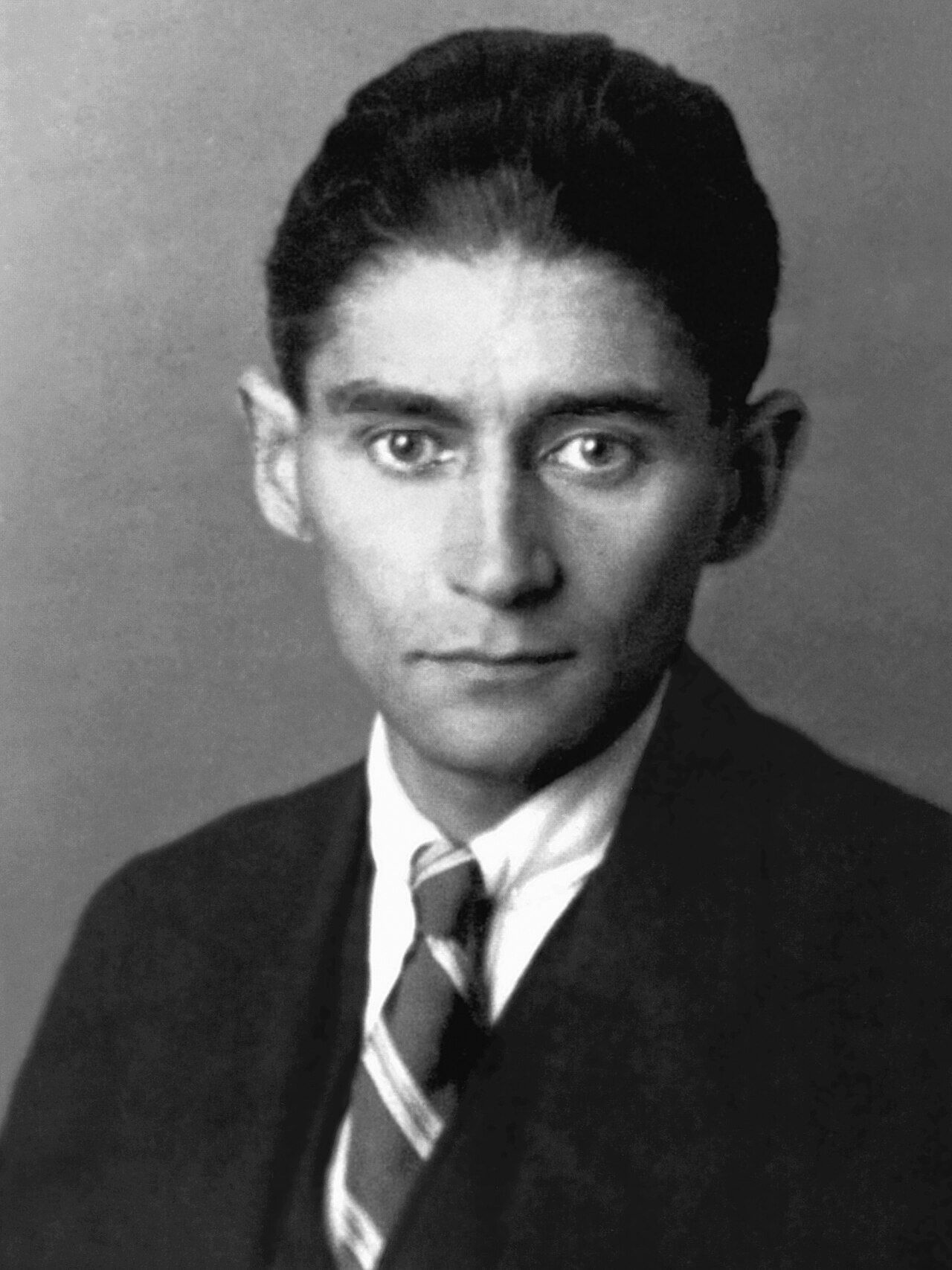
Franz Kafka
Franz Kafka (1883–1924) remains one of the most enigmatic and influential writers of the 20th century. Born in Prague, then part of the Austro-Hungarian Empire, Kafka’s life and works embody the tensions of a modern world filled with alienation, bureaucracy, and existential dread. His stories, though often rooted in surreal and absurd scenarios, capture universal human anxieties about identity, authority, and meaning.
Early Life and Background
Franz Kafka was born on July 3, 1883, in Prague into a middle-class, German-speaking Jewish family. His father, Hermann Kafka, was a successful, domineering businessman whose imposing personality deeply affected Franz throughout his life. Kafka’s mother, Julie Löwy, was more gentle and nurturing but struggled to balance the strong-willed husband’s influence. The household was one of contrasts—strict discipline mixed with cultural richness.
Kafka was a bright and sensitive child. He attended German-language schools, excelling academically but feeling socially isolated. He struggled with a sense of not belonging fully, caught between his Jewish heritage, the German culture of Prague, and the Czech environment surrounding him. These tensions would later echo profoundly in his literary work.
Education and Early Career
Kafka studied law at the German University in Prague, graduating in 1906. This path was partly pragmatic, motivated by family expectations to pursue a stable career. He worked for several years in insurance companies, notably the Workers’ Accident Insurance Institute for the Kingdom of Bohemia. His bureaucratic job, dealing with accident claims, deeply informed his understanding of the labyrinthine and impersonal nature of modern institutions.
Despite his demanding job, Kafka dedicated himself passionately to writing. His early works were published in literary journals, revealing a unique voice marked by surrealism, irony, and a profound exploration of human anxiety.
Literary Style and Themes
Kafka’s writing is famous for its distinct blend of the mundane and the absurd. His stories often place ordinary people in incomprehensible, nightmarish situations, reflecting a world where logic breaks down and the individual confronts impenetrable systems of power.
Key themes in Kafka’s work include:
- Alienation and isolation: Characters often feel disconnected from society, family, and even themselves.
- Authority and bureaucracy: Many stories critique oppressive, faceless powers that dictate fate without transparency.
- Guilt and existential anxiety: Kafka explores the human conscience burdened by inexplicable guilt and the quest for meaning in an indifferent universe.
His style is marked by precise, clear prose that contrasts with the surreal, often grotesque scenarios he imagines.
Major Works
Some of Kafka’s most celebrated works include:
- The Metamorphosis (1915): Perhaps his most famous story, it narrates the bizarre transformation of Gregor Samsa into a giant insect, exploring themes of identity, family dynamics, and social rejection.
- The Trial (published posthumously in 1925): A novel about Josef K., who is arrested and prosecuted by a remote, inaccessible authority without ever being told his crime. It epitomizes Kafka’s critique of impersonal bureaucracy and existential despair.
- The Castle (published posthumously in 1926): The story of a land surveyor trying unsuccessfully to access the mysterious authorities of a castle, representing alienation and the futile struggle against inscrutable power.
Kafka’s incomplete novels and short stories remain a treasure trove for literary analysis, illustrating his masterful ability to probe the human psyche’s darkest corners.
Personal Life and Relationships
Kafka was a complex and often troubled individual. He suffered from chronic anxiety, self-doubt, and feelings of inadequacy, particularly in relation to his father. These internal struggles are mirrored in his characters, who grapple with self-identity and authority.
His romantic life was marked by several intense, yet ultimately unfulfilled, relationships. Notable among them was Felice Bauer, to whom Kafka was engaged twice but never married. Their extensive correspondence reveals Kafka’s inner conflicts and longing for intimacy, shadowed by his fears and illness.
Health and Final Years
Kafka’s life was cut short by tuberculosis. Diagnosed in 1917, his health declined steadily over the following years. Despite his illness, he continued writing until shortly before his death.
In 1924, at age 40, Kafka died in Kierling, Austria. He had entrusted his unpublished manuscripts to his close friend and confidant Max Brod, instructing him to destroy them. Brod famously ignored this request, ensuring Kafka’s work would reach a global audience.
Legacy and Influence
Franz Kafka’s posthumous fame grew steadily throughout the 20th century. His writings gave birth to the term “Kafkaesque,” used to describe situations characterized by surreal distortion, oppressive complexity, and nightmarish bureaucracy.
Kafka’s influence spans literature, philosophy, psychology, and even popular culture. Writers such as Albert Camus, Jorge Luis Borges, and Gabriel García Márquez have cited him as a profound inspiration. His exploration of alienation and absurdity resonates deeply in modern existential thought.
Today, Kafka is considered one of the great modernist writers, whose visionary work continues to provoke and inspire readers worldwide. His penetrating insights into human nature and society remain eerily relevant in an age dominated by complex systems and shifting identities.
Curious Facts About Franz Kafka
- Kafka wrote most of his famous works while working full-time as an insurance officer, often writing late at night after exhausting days.
- Despite his profound influence on literature, Kafka published very little during his lifetime and instructed his friend Max Brod to destroy all his unpublished manuscripts—orders that were famously ignored.
- He had a complicated relationship with his father, which deeply influenced his writing, especially themes of authority, guilt, and alienation.
- Kafka’s unique writing style blends elements of surrealism, existentialism, and absurdity, creating worlds where ordinary situations become nightmarish and illogical.
- He was engaged twice but never married, reportedly due to his health problems and intense self-doubt.
- Kafka was fluent in German (his native language), Czech, and had knowledge of Hebrew, reflecting his diverse cultural background.
- His novella The Metamorphosis, about a man who transforms into a giant insect, is one of the most analyzed and referenced works in modern literature.
- He suffered from tuberculosis for several years, which eventually led to his early death at 40.
- Despite his Jewish heritage, Kafka’s religious beliefs were complex and often ambivalent, and he was more interested in philosophy and mysticism than organized religion.
- Many modern terms and concepts in psychology and philosophy, such as “Kafkaesque,” derive directly from the mood and themes of his works, describing surreal, oppressive, and bureaucratic nightmares.