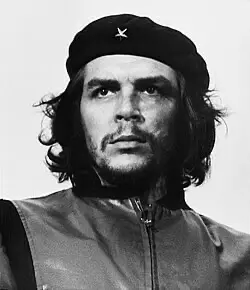
Ernesto «Che» Guevara
Ernesto Guevara de la Serna (June 14, 1928 – October 9, 1967), commonly known as Che Guevara, was an Argentine Marxist revolutionary, physician, author, guerrilla leader, diplomat, and military theorist. He was a key figure in the Cuban Revolution and held several high-ranking positions in the post-revolutionary government of Fidel Castro.
A polarizing global symbol, Guevara is regarded by many as an icon of rebellion, anti-imperialism, and socialist ideals, while others criticize his use of violence and role in political executions. His stylized image remains one of the most recognizable in popular culture.
Early Life and Education
Ernesto Guevara was born in Rosario, Argentina, into a middle-class family with liberal and aristocratic roots. He suffered from chronic asthma throughout his life, which shaped his personality and discipline. Guevara pursued a medical degree at the University of Buenos Aires, graduating in 1953.
During his studies, he undertook several long trips across South America. The most influential was his 1952 motorcycle journey with his friend Alberto Granado, during which he observed widespread poverty, social inequality, and exploitation. These experiences deeply affected him and formed the ideological foundation for his later revolutionary beliefs. His travel journals were later published as The Motorcycle Diaries.
Political Awakening in Guatemala
In 1954, Guevara traveled to Guatemala, where he supported the reformist government of President Jacobo Árbenz, which was overthrown in a CIA-backed coup. Witnessing the U.S. intervention led Guevara to embrace Marxism-Leninism and to view U.S. imperialism as a major obstacle to Latin American sovereignty.
Following the coup, Guevara fled to Mexico, where he met Fidel Castro and his brother Raúl Castro in 1955. The Castro brothers were planning an armed insurrection against Cuban dictator Fulgencio Batista. Guevara joined the 26th of July Movement and began military training with the group.
Role in the Cuban Revolution
On December 2, 1956, Guevara landed in Cuba aboard the yacht Granma with 81 insurgents. After being ambushed by Batista’s forces, only a few survived, retreating to the Sierra Maestra mountains to wage guerrilla warfare.
Guevara quickly rose to prominence as a military commander, known for his discipline, ideological commitment, and strategic acumen. He played a critical role in key operations, including the decisive Battle of Santa Clara in December 1958, which contributed to Batista’s downfall.
The Cuban Revolution triumphed on January 1, 1959, and Guevara became a naturalized Cuban citizen. He assumed major roles in the new revolutionary government.
Government Positions in Cuba
Between 1959 and 1965, Guevara held various key posts in the Cuban government:
- President of the National Bank of Cuba (1959–1960)
- Minister of Industries (1961–1965)
- Diplomatic envoy representing Cuba abroad
He advocated for a centrally planned economy, industrial development, and the creation of the “new man”—a selfless, morally driven individual dedicated to collective well-being rather than material gain.
Guevara opposed the growing dependence on the Soviet Union and promoted moral over material incentives, leading to internal debates. Many of his economic initiatives failed, and his vision for Cuba’s industrialization proved largely ineffective.
Global Revolutionary Activities
In 1965, Guevara disappeared from public life in Cuba. He reemerged as a guerrilla leader in Africa, attempting to support leftist rebels in the Congo. The mission failed due to disorganization and a lack of local support.
In 1966, he secretly entered Bolivia under a false identity to spark a continental revolution. However, his efforts faced numerous obstacles: minimal local support, poor communication with Cuba, and coordinated opposition from the Bolivian army, advised by the CIA and U.S. military personnel.
Capture and Execution
On October 8, 1967, Guevara was captured during a skirmish in the Yuro ravine, Bolivia. Wounded and detained, he was taken to the schoolhouse in the village of La Higuera. The next day, October 9, he was executed without trial by Bolivian forces. His alleged final words to his executioner were: “I know you’ve come to kill me. Shoot, coward. You are only going to kill a man.”
His body was displayed to the media and later buried in a secret location. In 1997, his remains were discovered and transferred to Santa Clara, Cuba, where they now rest in a memorial mausoleum.
Ideology and Writings
Guevara was a committed Marxist-Leninist, advocating for armed revolution as a means to dismantle imperialist and capitalist structures. He authored several influential texts, including:
- Guerrilla Warfare (1961)
- Reminiscences of the Cuban Revolutionary War (1963)
- Socialism and Man in Cuba (1965)
- The Bolivian Diary (posthumously published, 1968)
His concept of «foco theory» proposed that small, mobile guerrilla units could spark revolutions in rural areas across Latin America. He also emphasized the moral dimension of socialism, arguing against material incentives and promoting self-sacrifice.
Legacy and Controversies
Ernesto «Che» Guevara remains one of the most controversial figures in modern history. Supporters celebrate him as a symbol of anti-colonialism, social justice, and revolutionary courage. He has inspired generations of activists, particularly in Latin America, Africa, and Europe.
Critics, however, highlight his role in political executions at La Cabaña prison, his support for violent insurrection, and the authoritarian elements of his ideology. Some accuse him of promoting economic failures and repressive practices during his time in power.
Despite the debates, his influence on leftist movements, political theory, and global iconography remains significant.
Cultural Icon and Symbol
Guevara’s photographic portrait by Alberto Korda, titled Guerrillero Heroico, is considered one of the most reproduced images in history. It has been used widely in popular culture, appearing on t-shirts, posters, and murals around the world.
This transformation of a revolutionary leader into a pop culture icon has been criticized for contradicting his anti-capitalist beliefs. Nonetheless, his image continues to symbolize resistance, nonconformity, and political idealism for many.
Published Works
- Guerrilla Warfare (1961)
- Reminiscences of the Cuban Revolutionary War (1963)
- Socialism and Man in Cuba (1965)
- The Motorcycle Diaries (published posthumously, 1993)
The Bolivian Diary (published posthumously, 1968)
Curious Facts about Che Guevara
- Origin of the nickname “Che”: The word “che” is an informal Argentine expression similar to “hey.” Ernesto Guevara frequently used it, and his Cuban comrades adopted it as his nickname.
- Medical doctor by training: Guevara earned a medical degree from the University of Buenos Aires in 1953, specializing in dermatology before fully dedicating himself to revolutionary activities.
- Lifelong struggle with asthma: Despite suffering from chronic asthma, Guevara endured harsh guerrilla conditions, including intense jungle warfare and mountain campaigns.
- Multilingual and well-read: Besides Spanish, Guevara was proficient in English and French, and he was deeply interested in philosophy, literature, and political theory.
- Featured on Cuban currency: As president of the National Bank of Cuba, Guevara’s signature appeared on Cuban peso banknotes, often signed simply as “Che.”
- Committed to austerity: Guevara rejected luxury and materialism, promoting the ideal of the “new man” who values community over personal wealth.
- Iconic photograph by chance: The famous image “Guerrillero Heroico” was taken in 1960 by Alberto Korda during a funeral, later becoming one of the most reproduced photos worldwide.
- Monitored by U.S. intelligence: The FBI and CIA tracked Guevara’s activities due to his growing influence as a revolutionary threat during the Cold War.
- Global honors and censorship: Streets and institutions bear his name worldwide, while some countries have banned or censored his image and writings for political reasons.
- Remains discovered decades later: After his 1967 execution, Guevara’s body was hidden for 30 years until found in 1997 and moved to a mausoleum in Santa Clara, Cuba.