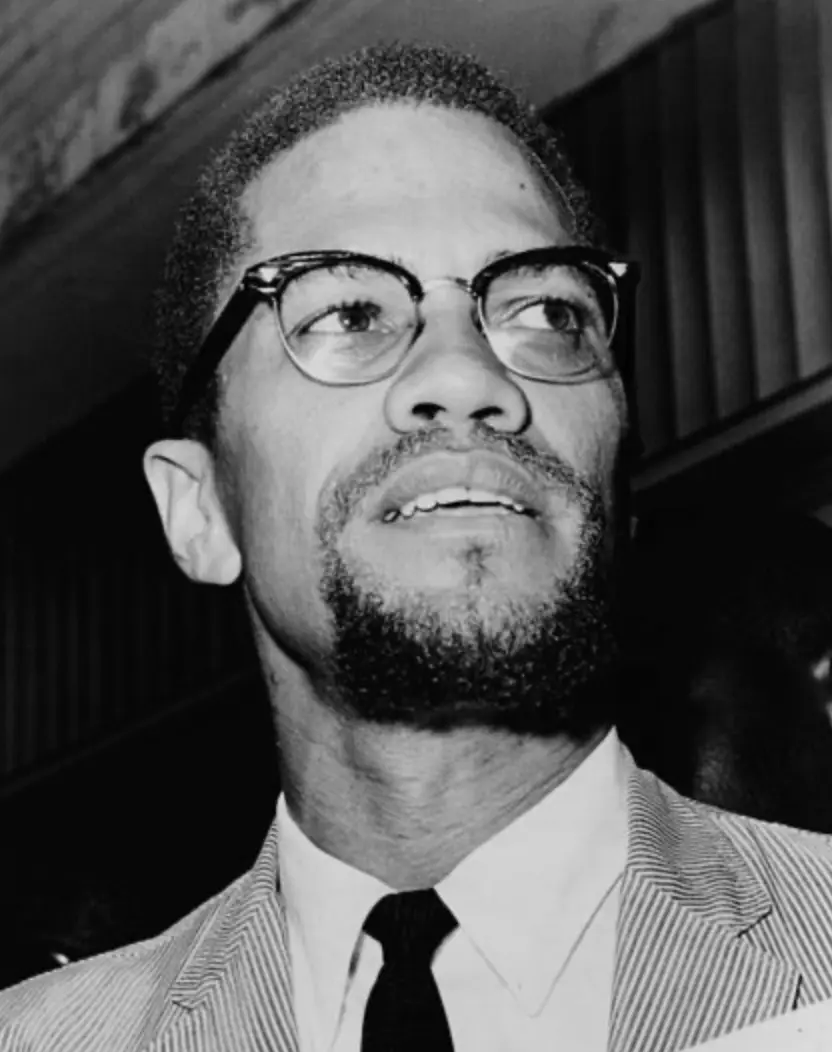
Malcolm X
Malcolm X (born Malcolm Little; Omaha, Nebraska, May 19, 1925 – New York City, February 21, 1965) was an African American leader, civil rights activist, Muslim minister, and one of the most influential figures in the fight against racial injustice in the United States during the 1960s. His philosophy had a significant impact on the rise of the Black Power movement and the political consciousness of African-descended populations both within the U.S. and globally.
Early Life and Education
Malcolm Little was born into an African American family frequently targeted by racial violence. His father, Earl Little, was a Baptist preacher and supporter of Marcus Garvey’s Black nationalist ideology. His mother, Louise Norton Little, was from Grenada and of mixed African and European descent.
The family was subjected to threats and harassment by white supremacist groups, including the Ku Klux Klan. In 1931, Earl Little died under suspicious circumstances—officially recorded as a streetcar accident, though his family believed he was murdered by racists. After his father’s death, Malcolm’s family faced severe financial hardship, and in 1939, his mother was institutionalized in a psychiatric hospital. The children were placed in foster care.
Malcolm excelled in school but became disillusioned after being discouraged by teachers who dismissed his goal of becoming a lawyer due to his race.
Crime and Incarceration
As a young adult, Malcolm moved to Boston and later to Harlem, adopting the nickname «Detroit Red.» He became involved in criminal activities, including robbery, drug dealing, and gambling. In 1946, he was sentenced to ten years in prison for armed robbery.
While incarcerated, Malcolm began a period of intense self-education. He immersed himself in books on history, philosophy, and religion, and eventually joined the Nation of Islam (NOI), a religious movement promoting Black nationalism and the rejection of white supremacy.
Nation of Islam
Upon his release in 1952, Malcolm renounced his «slave name» and adopted “X” as a symbol of his lost African heritage. As Malcolm X, he became one of the Nation of Islam’s most prominent ministers and public speakers under the leadership of Elijah Muhammad.
He established mosques in major cities such as Detroit, Boston, and New York, and used media appearances to advocate for NOI’s teachings. Known for his powerful rhetoric and unapologetic stance, he criticized systemic racism and promoted Black self-defense, economic independence, and cultural pride.
Unlike other civil rights leaders, such as Martin Luther King Jr., Malcolm X rejected nonviolence and racial integration, arguing instead for self-determination and sovereignty for African Americans.
Break with the Nation of Islam
By the early 1960s, Malcolm X grew increasingly critical of the NOI’s internal leadership and doctrine. He challenged Elijah Muhammad’s moral authority after discovering allegations of misconduct and began seeking a broader political and spiritual vision.
In March 1964, he formally broke away from the Nation of Islam and founded the Organization of Afro-American Unity (OAAU), modeled after the Organization of African Unity (OAU). His new approach emphasized Pan-Africanism, international human rights, and the global decolonization movement.
Later that year, Malcolm X performed the hajj (pilgrimage to Mecca), an experience that profoundly altered his views. He embraced Sunni Islam, adopted the name El-Hajj Malik El-Shabazz, and began advocating a more inclusive and global perspective on race and religion. He expressed hope for solidarity between oppressed peoples of all races.
Assassination
On February 21, 1965, Malcolm X was assassinated while speaking at the Audubon Ballroom in Manhattan. Three gunmen associated with the Nation of Islam shot him multiple times in front of an audience of roughly 400 people, including his wife, Betty Shabazz, and their children. He was 39 years old.
Though the assailants were convicted, later investigations raised questions about the role of U.S. government agencies such as the FBI and NYPD, which had monitored Malcolm closely and were accused of negligence or complicity.
Legacy
Malcolm X remains one of the most influential and controversial figures in American history. His autobiography, written with Alex Haley and published posthumously in 1965, has become a seminal work in African American literature and political theory.
He significantly influenced the rise of the Black Power movement, the Black Panther Party, and later cultural movements including hip-hop, Afrocentrism, and Black liberation theology. While critics once labeled him an extremist, modern scholarship highlights the evolution of his ideology, his intellectual growth, and his impact on global human rights discourses.
Today, Malcolm X is widely recognized as a symbol of Black dignity, resistance to oppression, and the transformative power of self-education and political awakening.
Interesting Facts About Malcolm X
- Malcolm X taught himself by copying the entire dictionary while in prison. During his incarceration, he improved his vocabulary and reading skills by transcribing every word in the dictionary by hand — a habit that shaped his eloquence and leadership in the civil rights movement.
- He was one of the most heavily surveilled civil rights leaders by the FBI. Malcolm X’s FBI file contained over 4,000 pages, documenting years of surveillance due to his political activism and influence in the Black nationalist movement.
- After joining the Nation of Islam, Malcolm X strictly followed Islamic dietary laws. He abstained from pork and other prohibited foods, maintaining these dietary practices even after leaving the organization and embracing Sunni Islam.
- His street nickname, “Detroit Red”, reflected his early life before activism. Before becoming a civil rights icon, Malcolm X was known for his reddish hair and time spent in Detroit’s criminal underground, which deeply influenced his later transformation.
- Malcolm X met world leaders during his travels across Africa and the Middle East. His 1964 international tour included meetings with influential figures like Egypt’s Gamal Abdel Nasser and Ghana’s Kwame Nkrumah, linking the African-American struggle to global anti-colonial movements.
- He often debated Martin Luther King Jr.’s nonviolent philosophy. Malcolm X publicly criticized the civil rights mainstream for being too passive, advocating instead for Black self-defense and independence — a stance that later influenced the Black Power movement.
- Malcolm X helped expand the Nation of Islam by establishing over 100 mosques. As a charismatic spokesperson, he was instrumental in growing the religious movement’s presence in major U.S. cities such as New York, Chicago, and Los Angeles.
- His legacy grew after his assassination in 1965. The publication of The Autobiography of Malcolm X, numerous documentaries, and the 1992 biopic directed by Spike Lee brought renewed attention to his life, ideas, and continuing relevance in discussions on racial justice.